Synastry Chart: What It Reveals About Two People
By:Author:Nordastro Editorial
Updated on:October 18, 2026
- Does Comparing Two Birth Charts Actually Tell You Anything?
- How the Planet Overlay and Aspect Angles Work
- How Often to Revisit a Synastry Reading
- Full Overlay Reading Versus Sun Sign Matching
- Working an Overlay Reading Into an Actual Relationship
- The Myth That a Chart Overlay Guarantees a Match
- What Changes How Useful an Overlay Reading Feels
- Where Compatibility Readings Go Wrong
- Reading a Synastry Chart Through Nordastro
- Making Two Charts Work for You, Not Just About You
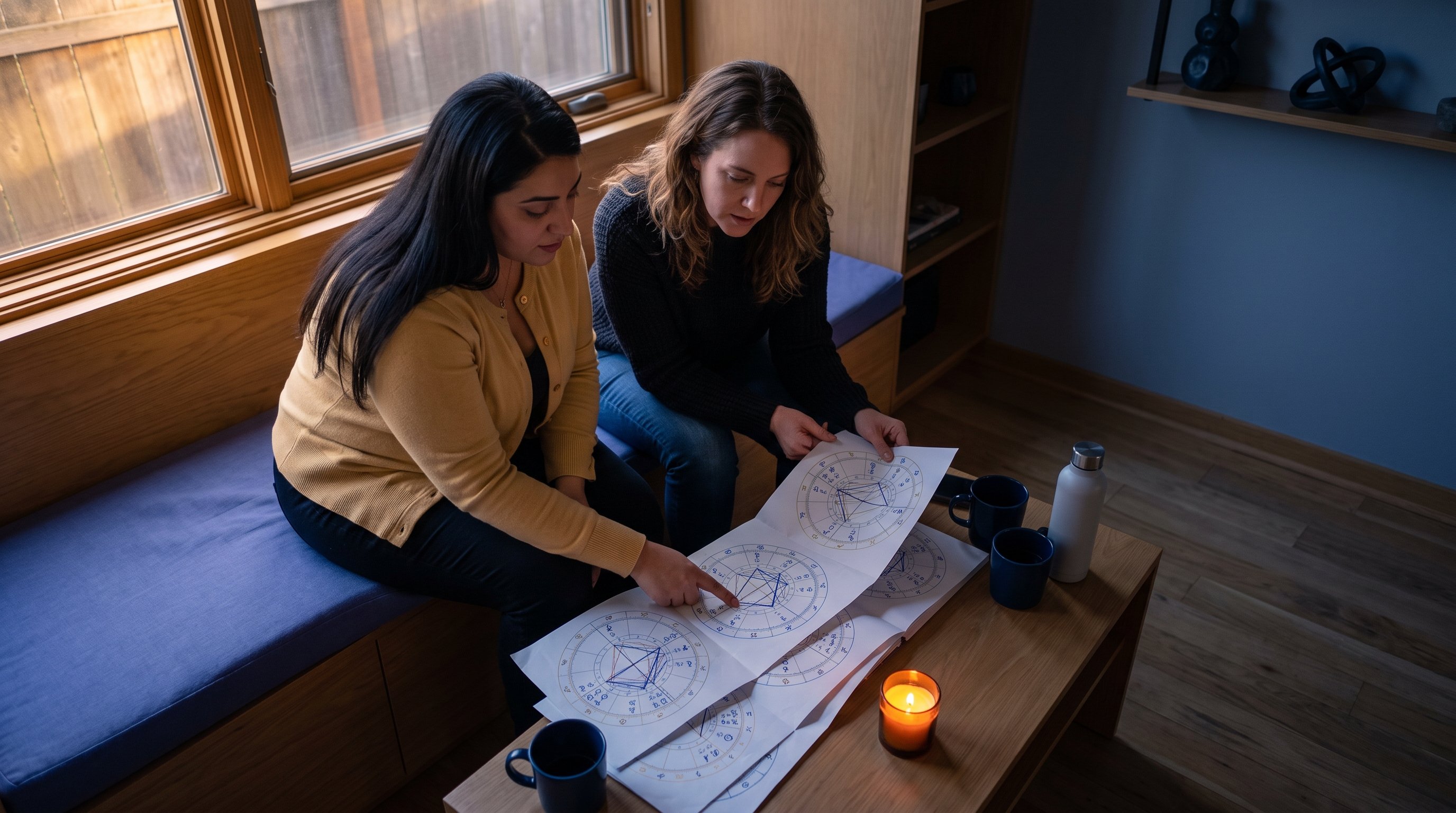
A synastry chart overlays two people's birth charts to see how their planets interact - where one person's Venus sits next to the other's Moon, for example. It does not say two people are destined for each other or doomed to clash; it shows patterns of friction and ease that play out in how you communicate, argue and support each other.
The mechanism is comparison, not prediction. Each planet in one chart forms an angle to each planet in the other chart, and those angles describe a dynamic - some easy, some tense, most somewhere in between.
This article walks through how the overlay actually works, how often it's worth revisiting, where people misread it, and how to fit this kind of reading into an actual relationship rather than just a curiosity exercise.
Does Comparing Two Birth Charts Actually Tell You Anything?
Yes, in the sense that it gives you specific, checkable detail instead of a vague feeling. Two sun signs that are supposedly a poor match can still have an overlay full of easy angles once you bring in Moon, Venus and Mars placements.
The arithmetic is plain: a birth chart has ten planets plus angles, so overlaying two charts gives you roughly a hundred planet-to-planet pairings to look at, not one single verdict.
A sun-sign-only comparison looks at 2 data points. A full overlay looks at dozens, which is why it tends to explain more of what you actually feel in the relationship.
This is reflection, not forecasting - the chart describes a pattern that often shows up, it does not script what either person will do with it.
How the Planet Overlay and Aspect Angles Work
Understanding this kind of reading comes down to two separate mechanics working together: where the planets land, and the angle they form once they're placed side by side.
Placing One Chart Over the Other
The first step takes both people's planet positions and lays them on the same wheel, so you can see exactly which sign and house each person's planets fall into relative to the other's chart. This is purely positional - it's just mapping, before any interpretation happens.
Reading the Angles Between Planets
The second step measures the angle, or aspect, between each pairing - close together, directly opposite, at a right angle, and so on. Each angle type describes a different flavour of interaction, from easy flow to friction that needs conscious work.
Neither step means much alone - a planet sitting in a particular house only matters once you check what it's angling toward, and an angle only matters once you know which planets are involved.
How Often to Revisit a Synastry Reading
The overlay itself doesn't change - the two birth charts are fixed. What's worth revisiting is which part of the overlay you focus on, since different areas of a relationship become relevant at different points.

Matching the Focus to the Moment
Early on, the Moon and Venus pairings tend to be the most practical to look at, since they describe comfort and affection. Later, Mars and Saturn pairings become more relevant once you're dealing with shared routines, friction and long-term commitment.
| Relationship Stage | Where to Focus | What It Shows |
|---|---|---|
| New relationship | Moon and Venus pairings | Comfort and attraction |
| Settling in | Mercury pairings | Communication style |
| Living together | Mars and Saturn pairings | Friction and routine |
| Long term | Full overlay review | Overall pattern recap |
Full Overlay Reading Versus Sun Sign Matching
Sun sign matching is quicker - look up two signs, read a generic paragraph, done. A full overlay takes longer because it needs accurate birth details and a proper comparison of every planet pairing, not just one.
The trade-off is obvious once you think about it in numbers: sun sign matching uses 2 data points out of the dozens available in two full charts.
People stick with the full overlay once they've seen it explain something a sun sign match could never catch, like why two supposedly 'incompatible' signs still get on fine day to day.
Working an Overlay Reading Into an Actual Relationship
The most useful way to use this kind of reading isn't as a one-off verdict but as a reference you return to when something specific comes up - an argument pattern, a communication gap, a difference in pace.
That's easier when both people's charts are already laid out clearly rather than reconstructed from memory each time. Nordastro's app includes a compatibility check built on both people's details, so the overlay is there to look at whenever it's actually relevant, not just once out of curiosity.
Keeping that reference handy means the reading stays useful past the first look, which is where most casual compatibility checks lose their value.
The Myth That a Chart Overlay Guarantees a Match
No overlay can promise two people will work out, and no amount of easy angles replaces actual effort or communication. A chart describes dynamics, not outcomes - it can't account for what either person chooses to do.
Two charts full of difficult angles can still support a strong relationship if both people understand where the friction tends to show up and work with it deliberately.
The honest answer is that a synastry chart hands you a map of tendencies, not a verdict - what two people build with that map is still entirely up to them.
What Changes How Useful an Overlay Reading Feels
A few things decide whether this kind of reading actually lands or just sits there as trivia.
What Makes the Biggest Difference
- Accurate birth times for both people - a few minutes off shifts house placements enough to change what the overlay actually shows.
- Looking at the whole picture, not one pairing - a single tense angle means far less once you see it sitting alongside a dozen easy ones.
- Revisiting it at relevant moments - the reading means more when it's checked against a real situation instead of read once and filed away.
Where Compatibility Readings Go Wrong
Fixating on One Difficult Angle
It's easy to spot one tense pairing and treat it as the whole verdict on the relationship. Look at the full set of pairings before drawing any conclusion from a single angle.
Guessing at Birth Times
Using an approximate birth time throws off house placements for both charts, which changes what the overlay actually says. Use the most accurate time available, even if that means checking a birth certificate.
Treating It As a Pass or Fail Test
Reading an overlay like a compatibility score misses the point - every real pairing of two people includes both easy and difficult angles. Read it as a description of dynamics to work with, not a grade.
Ignoring the Rest of Each Chart
A synastry overlay sits on top of two full individual charts, and skipping those leaves out context that explains why certain angles matter more for these two specific people. Check each person's own chart alongside the overlay for the fuller picture.
Reading a Synastry Chart Through Nordastro
Nordastro's book starts with a customized birth chart analysis built from your own birth details, covering the strengths, challenges and growth paths that shape how you show up in a relationship before any overlay even comes into it.
The accompanying app adds the piece that matters most for this kind of reading: the ability to check compatibility with anyone, alongside daily guidance so the chart stays part of ordinary life rather than a one-off lookup.
Discover What Awaits You
See Your Future Today
Making Two Charts Work for You, Not Just About You
Pick one relationship you're curious about and get both birth details right - date, time and place - before anything else. The overlay is only as useful as the accuracy going into it.
From there, start with the Moon and Venus pairings since they're usually the easiest to recognise in daily life, then widen out as questions come up. Nordastro's compatibility feature keeps both charts in one place, so you can check back on it whenever something in the relationship calls for it.
FAQ
No - it describes patterns of ease and friction between two charts, not fate. What two people do with those patterns is still down to them.
Not quite - sun sign matching uses one data point per person, while an overlay compares dozens of planet pairings across both charts. That's why two people with 'incompatible' sun signs can still show an easy overlay overall.
An approximate time still lets you read the planet-to-planet angles, though house placements will be less precise. Getting an exact time later, from a birth certificate if possible, sharpens the reading.
Difficult angles describe friction to work with, not a reason to end things - plenty of strong relationships have charts full of them. Nordastro's compatibility check lets you look at the full pairing rather than fixating on one tense angle.
Share this post